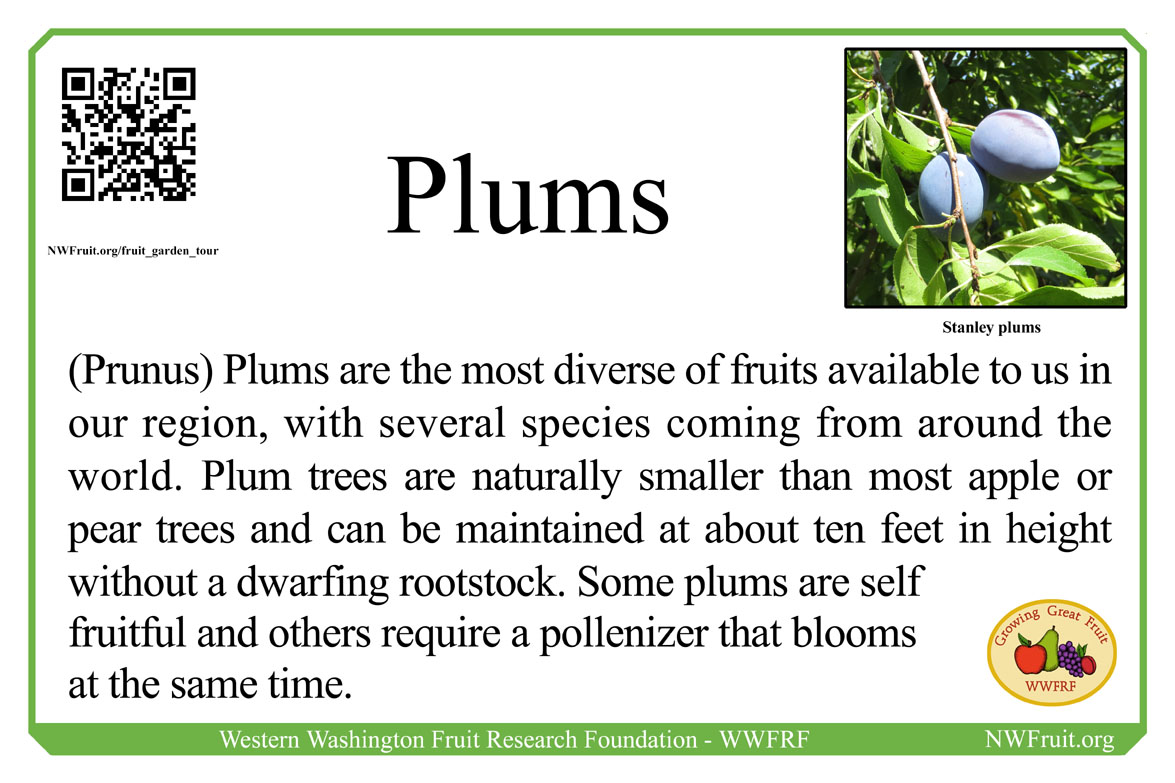
The Plum sign in the fruit garden marks a row of delicious plums. However, unlike some of the other fruits, the plums are spread throughout the garden. You will also find them along the south and west fences as well as in the outer oval. The descriptions of each plum is included along with where in the garden you can find each tree.
About Plums
(Prunus species) Plums, unlike most other fruits, come in a great variety of colors, textures and flavors. Although all in the genus Prunus, plums are of several different species and come from many parts of the world. Because apples and pears are each in separate genera they generally cannot be successfully grafted on the same tree. Plums, peaches, almonds and apricots are also in the genus “Prunus” and can be grafted onto a single unique tree. Cherries are also in the genus Prunus. Until recently they could not be grafted on a tree with plums but recent advancement in rootstocks has now made that possible.
European plums generally have a more upright growth habit than Asian Plums and take longer to begin bearing. Most of our plums are on the semi dwarfing Marriana 2624 rootstock and should be spaced about 15 feet apart.
Plum Pollination
Asian Plums generally bloom earlier in the spring than do European plums and since their bloom times are different they don’t cross pollinate. Some plums are self fertile
and others require a different variety that blooms at the same time as a pollinizer. Look at the pollination charts to see which varieties to choose for adequate pollination.
European Plums
European plums come in a great array of colors and delicious flavors and are great for fresh eating, drying, preserves, liquors and other uses. These include many varieties of Prune Plums, which are purple in color and are prized for drying as well as fresh eating. Other proven European plum types include Mirabelles, Gages and Damsons. Some plums are self fertile but most require another variety that blooms at the same time as a pollinizer. Consult a pollination chart. The Mirabelles are a type of small yellow plums from the Alsace Lorraine border area of France and Germany. Select two different Mirabelles for the best pollination. They make a delicious jelly and are used in many recipes.
Descriptions of European Plum varieties and their location:
Asian Plums
Of all the fruit trees in the garden, Asian Plums are arguably the most productive and quickest to bear. Many are self fertile. The fruits are softer but juicier and sweeter than European plums. The tree’s growth habit is usually spreading. They produce so many branches that a lot of them need to be thinned out to allow sunlight in to ripen the fruit.
If you were to have only one fruit tree in your yard, a self fertile Asian Plum like Methley or Early Golden may give you the most fruit with the least problems. Asian Plums flower very early in Spring, however they withstand temperatures even five degrees below freezing or even a snow storm during bloom and set good crops anyway.
When grown as an espalier, Asian Plums are often trained in a fan pattern. Many Japanese plums will fruit on 1 year wood as well as on fruiting spurs. Upward growing newer branches can be used for renewal wood every few years as they will bend down with the weight of the fruit and the drooping older wood can be cut out.
Proven Asian varieties and crosses include Methley, Early Golden, Beauty, Shiro, Obilnaja and the red leafed Hollywood. Our plums are situated along the South and West Fences as well as in our plum block. East description includes where in the garden the tree is located.
Descriptions of each Asian Plum variety and its location in the garden:
Plum Crosses
Luther Burbank was among many plant breeders who crossed Plums with other fruits of the Genus Prunus. He developed a plumcot which is a plum X apricot. In recent years Floyd Zaiger has bred many interesting crosses including Apriums which are 3⁄4 Apricot and 1⁄4 plum and Pluots which are 3⁄4 plum and 1⁄4 apricot. Also crosses of peach and plum. While they grow well here, they don’t acquire the brix or sugar content because of a lack of summer heat here in Western Washington. They don’t have the sweet flavor they do in California. However we are successfully growing a Zaiger bred fruit called a Pluerry which is an Asian Plum crossed with a Cherry. They look like and are pollinated by Asian plums. They have a unique rich flavor that is mostly like an Asian plum but with a hint of cherry flavor. We have the varieties Sweet Treat and Candy Heart and have top worked the varieties Sugar Twist and Nadia on to them. See the Pluerries at Station #20.