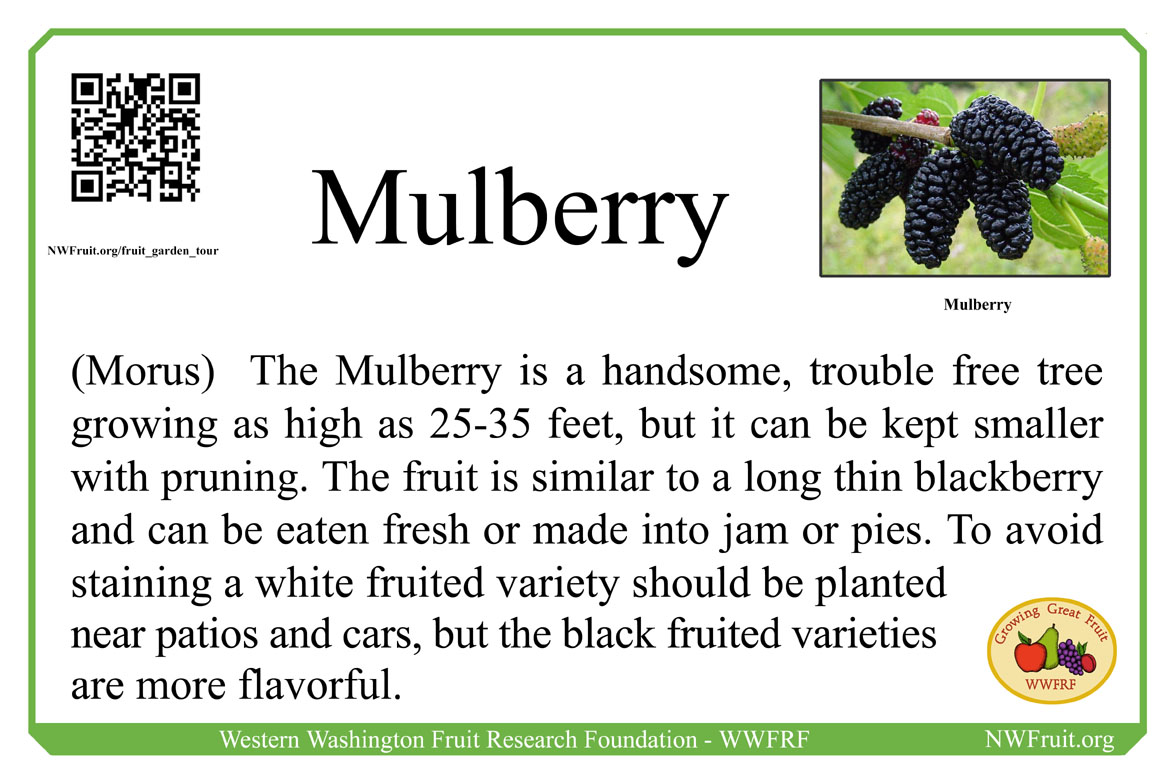
(Morus species alba and rubra) Mulberry trees thrive in our climate. Most varieties are either alba or rubra or a cross of the two. Their fruit goes from green to red and then to black when ripe. Varieties are self fertile and hugely productive. The fruit looks like an elongated thin blackberry. The flavor is delicious and unique with hints of coconut and cherry. Though birds reportedly love the fruit, we still get huge crops of delicious fruit. The trees are self fertile.

Though the trees we have are called Morus Alba, their fruit turns black when ripe. There are also Morus alba varieties that have fruit that remain white when ripe. Also there are Morus nigra varieties that make huge trees with very good flavored fruit. Those varieties will grow here though they are not as winter hardy as the Morus Alba and rubra. We don’t have Morus nigra growing here now.
Mulberries are very vigorous trees that will get very large. Allow them at least 20 feet of space. They generally are grown as an open center tree and will benefit by thinning out competing branches. If the trees grow tall so you can’t reach most of mulberries it won’t hurt to cut the tree way back. However this will result in a lot of new upright growth that will then need to be thinned out. You can allow the Mulberry to grow as a tall stately ornamental. If you want to be able to reach the fruit from the ground you will need to use pruning to keep the tree small. It can also be grown as a multi stemmed shrub and cut back each year.
Oscar
(W4, A 21 planted 2010)(Malus alba x rubra) The tree is very vigorous and spreading and it is loaded with fruit that has a hint of black cherry flavor when black and fully ripe and hints of raspberry when they are red and still fully ripening. The variety is named for Oscar Clark, a breeder from Riverside California.
Pakistan
(W5, A 28 planted 2024) (Morus macroura) The three to four inch long berries have a sweet complex flavor and ripen over more than a month in July and August. The tree is very productive and thrives in our area. It thrives in the mountains of Pakistan with its long hot summers. Fruit is purple black when ripe and are also tasty before they are fully ripe when they turn red. The tree is very vigorous and spreading with large heart-shaped leaves.