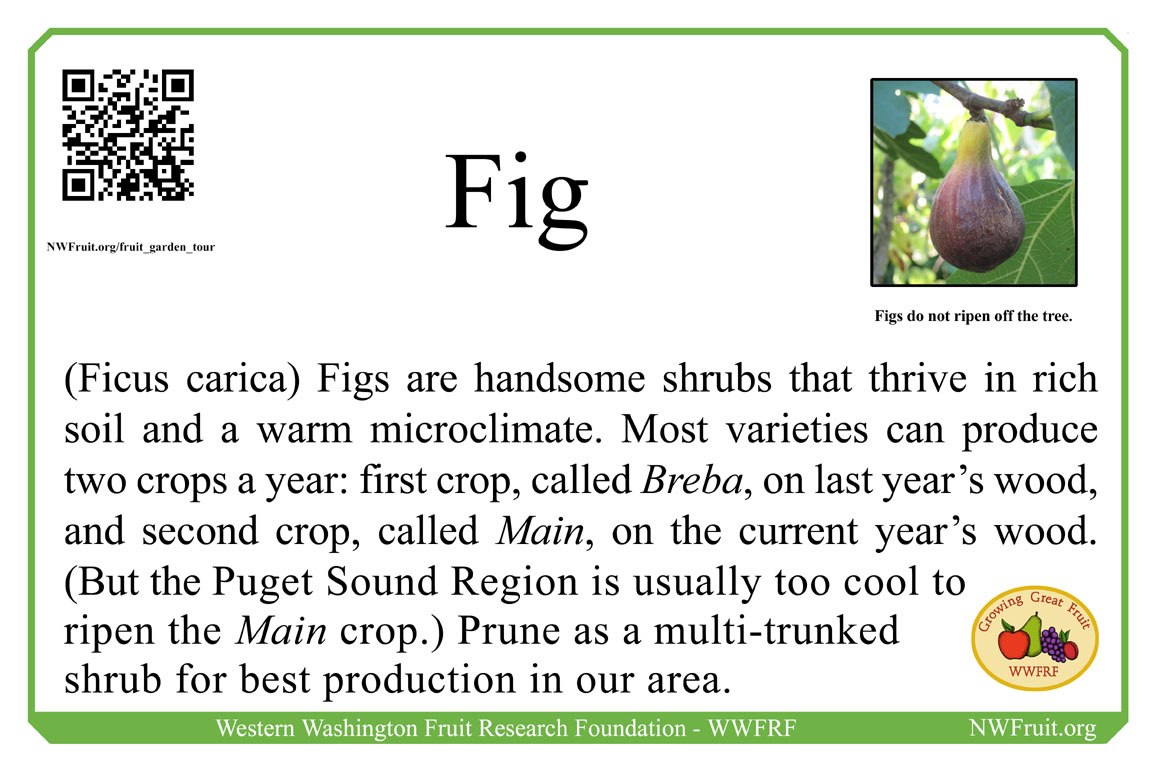
(W3, F14 planted 2024) Our climate is conducive to successfully growing delicious figs but only if you choose the right varieties and niches in your garden. Choose the sunniest, warmest corners of your yard, maybe warmed by being near a heated house. While figs can get to be beautiful tropical looking large trees, often keeping them cut back and shaped in an open or even fan shape will keep all your figs at a height where you can pick them.
The nearby ocean protects us, most of the time, from winter temperatures below 10 degrees F. which will kill back fig trees to the ground. We put chicken wire and straw or chips around the base of our plants when they are young to protect them from those hard freezes. With protection around the base, even if the unprotected part dies back, it will very quickly regrow from the base and your plant will soon again be productive.
The coastal influence that moderates our winter temperatures also mean that we do not get the summer heat units found in most of the nation that are needed to ripen a fall crop. So we are looking for cultivars with a very early ripening fall crop. However most figs also produce an overwintering “breba” crop. These tiny pea size fruit over winter, next to a leaf bud and the breba crop ripens here, usually in August. So we are trialing cultivars noted for a heavy “breba” crop.
San Pedro Figs
Alas there is a unique type of fig called a “San Pedro” fig that without pollination from a wasp, that we do not have, only produces a “breba crop”. Without pollination, what would be the fall crop never ripens. For years our region’s most reliable and tasty fig has been the Desert King which is a San Pedro fig. So we have other San Pedro type figs to try.
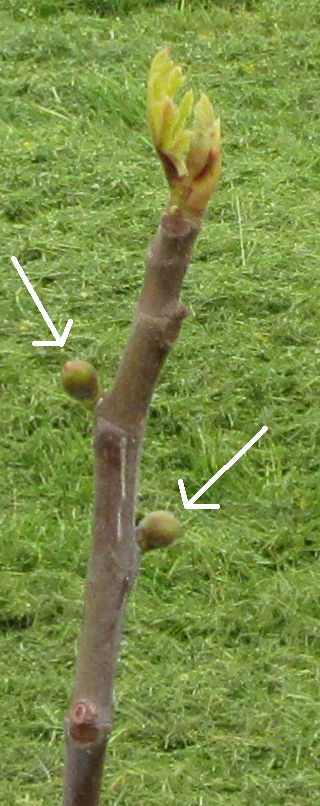
Fig Pruning
Prune about 1 out of every 3 limbs back to, or nearly back to, its source each spring to encourage renewal growth. The new shoots forced to grow as a result of pruning will produce their Breba crop the following year. Figs taste best if picked when soft to mushy and drooping straight down. Some figs are green when ripe and others are darker.
Photos of figs and fig pruning
The latest fig trial at WWFRF was initiated in the spring of 2024 with 9 different fig varieties. In the spring of 2025 another 9 different varieties were planted in the adjoining row. The goals of the trial are to:
- Identify varieties of productive, good tasting figs for western Washington.
- Identify appropriate growing and pruning techniques to maximize fruit yield.
- Identify appropriate over-winterizing techniques for figs in western Washington.
The figs are in two rows:
South row, from West to East:
- Little Ruby
- Olympian
- Brown Turkey
- Ronde de Bordeaux
- Nordland
- Madeiline de deux Saisons
- Grantham’s Royal
- Desert King
- Lattarula
North row from West to East:
- Norman’s Yellow
- Dauphine
- Dominico Tauro (weak, maybe replaced)
- Italian 376
- Rupenco Black Mission (weak, maybe replaced)
- LSU Purple (weak, maybe replaced)
- Neveralla
- Gulban
- Violette de Bordeaux
- Stella (to plant in 2027)
- Beall (to plant in 2027)
The varieties in the Fruit Garden trial are:
Little Ruby
It is tiny but mighty! So small it’s grown by some as a bonsai specimen, it both ripens a
fall crop regularly in Western Washington and other cool summer areas and also sets an
overwintering “breba” summer crop. Little Ruby comes from near Olympia WA and was
introduced by Denny McGaughy, who also introduced the Olympian fig into commercial
cultivation.
Olympian
Along with Desert King, Olympian is the best bet for cool summer areas. This newly
available fig was found in Olympia Washington and regularly ripens a sizeable breba
crop in August and often a fall crop in cool summer areas where others fail. Introduced
by Denny McGaughy.
Brown Turkey
This fig is one of the most reliable in our region. The skin is mahogany in color and the
flesh is a light amber and very sweet. The hardy tree will bear heavily and can have two
crops of large delicious fruit a year.
Ronde de Bordeaux
It ripens one of the earliest main crops, as early as August in PNW. Figs are similar to
the other famous fig from Bordeaux, Violette de Bordeaux a.k.a. Negronne, but are
slightly smaller and not quite as dark in skin or flesh but with a delicious berry flavor.
Nordland
This variety, Nordland Bergfeige is originally from Switzerland and considered among
the hardiest figs. It is able to survive to 10 degrees F and possibly lower. It is a brownish
fig with a very tasty melony sweetness. It is recommended as a good choice for cooler
maritime climates and it has proven to thrive at the WSU Mt. Vernon station in Western
Washington. It makes a breba crop with good flavor, and a very prolific main crop that
ripens even in cool summers.
Madeliene des deux Saisons
It was found regularly producing two crops on the cold and rainy coast of Brittany in
France. The breba crop has proven to ripen in August in the Pacific Northwest. Also
known as Angelica, this fig is from the Anjou region of France and is excellent eaten
fresh, dried, or made into preserves. It is called Madeleine of “two seasons” because
it ripens not only the “breba” overwintering crop in August but often a fall crop in
October.
Grantham’s Royal
A very large purple fig with pinkish-amber flesh; a heavy breba crop ripens
mid-August. A San Pedro type.
Desert King
Top rated in the Pacific Northwest. A large fig with dark green skin and pink flesh. It is
the most consistent cropper in our region. It only produces one crop each year, in
August, produced on the previous season’s growth. A San Pedro type.
Lattarula
Among the most popular and widely adapted varieties; a member of the White
Marseilles family of fig cultivars. It has amber colored flesh and a yellow-green skin. Its
fine quality for canning, drying and fresh eating, has earned it the name Italian Honey
Fig. This reliable and hardy variety has been producing delicious figs for many years in
the Pacific Northwest. Lattarulla can bear two crops in one season, one ripening in late
July and the second in mid-September.
Violette de Bordeaux
The very productive tree/bush can produce two crops of purple/black figs with rich,
raspberry-colored flesh. It has high quality figs with a concentrated texture and deeply
sweet flavor. It has been recommended for short-season and cool summer growers and
is well-suited to growing in pots, as well as reportably being disease and pest resistant.
Very similar to Petite Negri but slightly later to ripen.
Beall
It is a chance seedling of a caprified Osborne Prolific that reportedly produces abundant
first (breba) crops every summer about the same time as Desert King in cool, wet, Elma
Washington. The moderate second (main) crop ripens early, before Little Ruby. The figs
are glossy black with a white to pale amber sweet and rich tasting interior when ripe.
The smooth shiny skin of the fruit resists rain damage and spoilage, allowing them to
remain on the tree until fully ripe in wetter ripening seasons.
Gulban
A large light green to pale yellow fig with a translucent pulp tinged with pink. Good
flavor. Seems moderately hardy. Bred by Ira Condit.
It reportedly has a large and tasty breba crop and the main crop figs are fairly early and
will usually ripen in Western Oregon.
Italian 376
This introduction from Italy produces a good sized breba crop as well as a large main
crop. Figs have a beautiful deep red to purple skin and a bright red flesh with a fantastic
berry flavor.
LSU Purple
Reportedly one of the best of many excellent varieties to come out of the LSU fig
breeding program. LSU Purple is very prolific, producing large breba and main crops of
sweet, caramel-flavored figs. LSU Purple is very adaptable to many climate types,
thriving in the Southeast as well as the Pacific Northwest and warmer climates. The
small, closed eye makes it resistant to spoiling and is very adaptable to container
culture.
Neverella
It does very well in cool coastal climates. It has a low heat requirement and will even
fruit in partially shady areas. Neverella has brown skin with an opalescent flesh. It is
delicious eaten fresh, canned, or preserved. This medium sized fig is another great
option for container gardening. It has been found to be genetically similar to figs from
Turkmenistan, a group of figs that “may represent non-Mediterranean type wild figs
found in the Hyrcanic regions of the south Caspian Sea.
Rupanco Black Mission
From an old homestead growing near the shores of Lago Rupanco in northern
Patagonia, this fig produces wonderfully, even in that very cool maritime climate, as it
has a large and productive breba crop. This is almost certainly a Black Mission fig, as
this was one of the more common varieties being introduced to the Americas in the 18th
and 19th century, though the leaf shape isn’t an exact match, so we’re keeping the
Rupanco tag on it. But it is effectively Black Mission, a long beloved fig in California, and
one that has been underutilized in cooler climates as it seems the word has not gotten
out about how productive and delicious its breba crop is.
Norman’s Yellow
A short season fig with a prolific and delicious Breba crop. The tree is much like Desert
King except for the yellow fruit color. The fruit has a strong honey flavor. It is a San
Pedro type.
Dauphine
Dauphine comes from France and is highly regarded in that country for the size and
productivity of its breba crop.. The breba fruit are large to very large, between 100 and
200 g in weight with handsome green tinged with purple skin and light rosy pink flesh.
Its only potential disadvantage may be frost hardiness as it is apparently more tender
than some other figs with significant dieback at 14 degrees F. Dauphine was tested in
the past at the Mt. Vernon research station in Western Washington and reported to
produce two crops each year and the breba crop ripened well and tasted good.
Domenico Tauro
An Italian variety, great potential due to its large Breba crop, figs are purplish brown,
quite large and delicious.
Stella
The original tree was found in a Southeast Portland neighborhood. The tree was brought
there many years ago by an Italian sailor and is now cultivated and marketed under his
wife’s name (Stella). The tree has large size fruit, with sweet, striking, purplish-red
flesh. It has the ability to ripen in a cool climate.