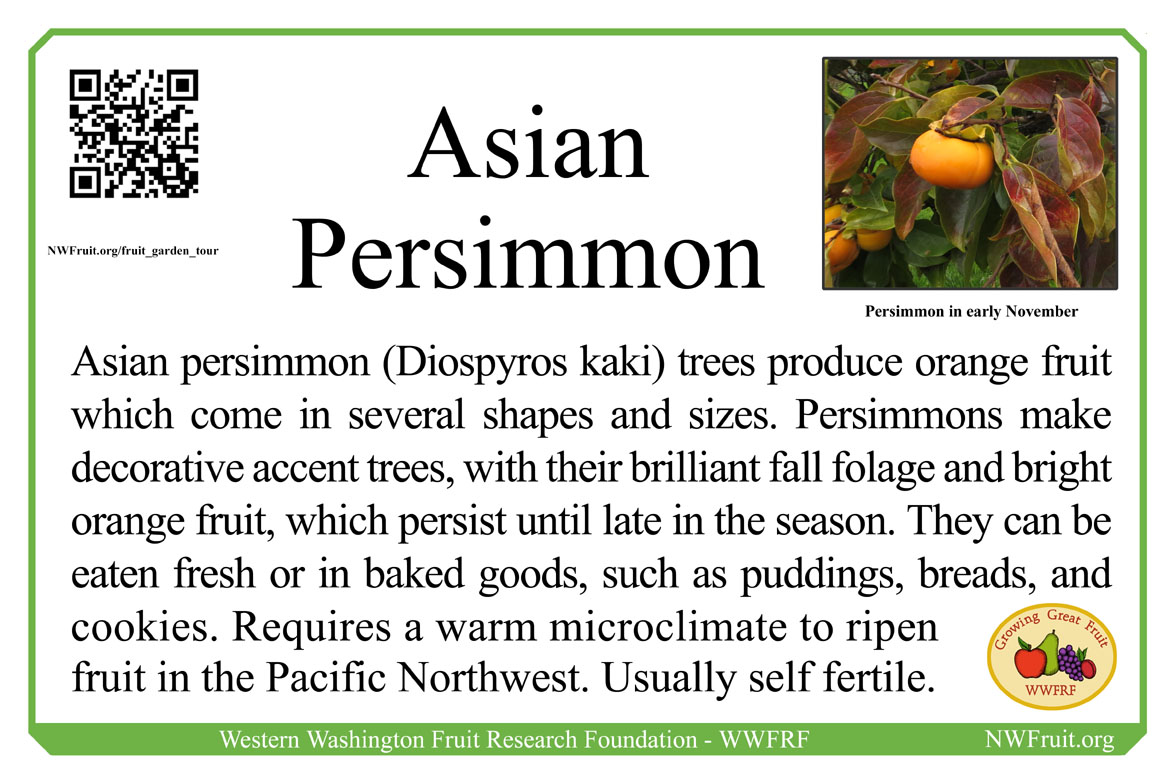
(W5 to E5 along #28 north row) Persimmons were long thought not to ripen in most of Western Washington. In recent years, Northwoods Nursery has provided varieties which are delicious and ripen here, though picking a location that maximizes summer heat is still important.
Both Asian (Diospyros kaki) and American (Diospyros virginiana) varieties will grow and thrive in the maritime Northwest. It is the Asian varieties that have larger fruit and are not as winter hardy that are grown commercially, mainly in California.
Persimmons are tolerant of a variety of soil types and are easy to grow. Young trees should be irrigated, but older trees are more drought-tolerant. They should be pruned to a multi-trunked open center or a central leader scaffold system. Pruning is usually not required on older trees except to maintain tree size or correct faults such as broken limbs. Fruit is born on the current year’s wood.
Persimmons are susceptible to biennial bearing, with a larger crop every other year. To avoid this, thin at least half of the developing fruit within a month of bloom if the fruit set is heavy. A mature tree can produce 35 to 75 lbs. of fruit. Harvest persimmons with hand clippers and cut close to the calyx. They can be stored for up to 3 months just above freezing. Unripe persimmons will become more ripe in a warm room.
Trees may be propagated by seed, root cuttings or grafts, but seeds must be cold-stratified to produce. Seedlings should be transplanted into the orchard when they are 1-2 years old, since older trees develop a taproot that makes transplanting difficult. Persimmons will begin bearing in 4-8 years depending on the method of propagation.

American Persimmons
American varieties, which make a larger tree, but a smaller fruit, are native to the East and Mid-west and are very winter hardy. Unripe fruit of American persimmons can be astringent and should be allowed to ripen on the tree late into the fall, to be harvested after a frost when the flesh becomes soft and sweet.. For years, American Persimmons needed a male tree as a pollinizer. An exception was the variety Meader which had both male and female flowers. In recent years there are several early ripening self pollinizing cultivars available. These include Szukis and the Prairie series including Prairie Star and Prairie Dawn. For the heaviest fruit set it can be good to also have a male tree. Choose a site with full sun and allow the fruit to ripen on the tree, even into freezing temperatures. We have the following variety:
Prairie Star
Also known as Claypool H118, it has comparatively large, very flavorful fruit and is very early ripening and self fertile.
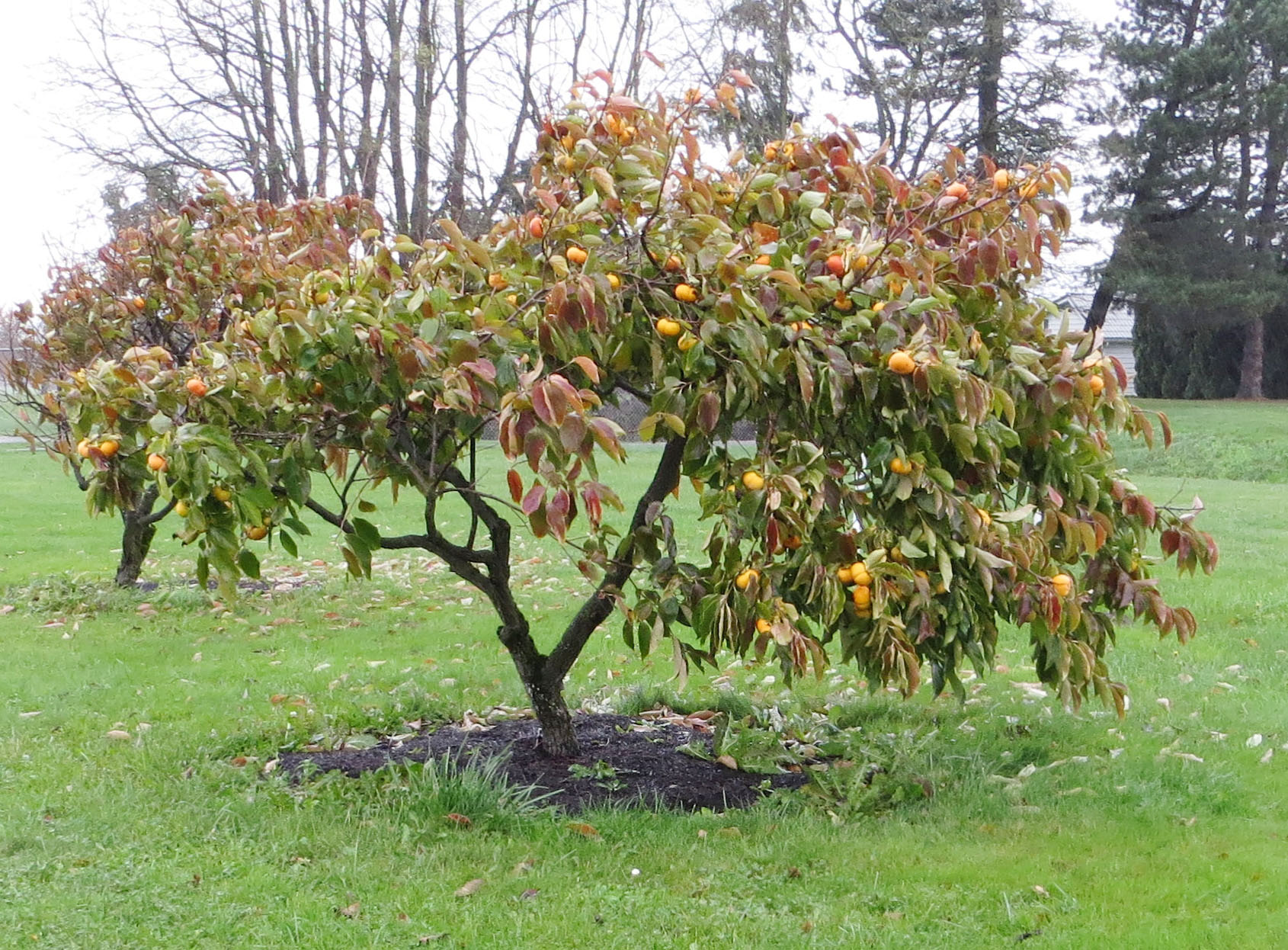
Asian Persimmons
Asian Persimmons can be divided into two distinct types, astringent also known when ripe as soft-sweet and non-astringent known when ripe as crisp-sweet.
The Asian astringent cultivars, like the Americans, are eaten in the fall after a heavy frost when they lose their astringency and the flesh becomes soft and syrupy sweet.
Saijo
An old Japanese variety with excellent flavor that usually ripens in our region. The fruit is about three inches long and conical in shape.
The non astringent types are more the texture of eating crispy persimmon flavored apples. They need to ripen into the autumn and when they start turning a bright orange color and they get a little bit softer, they can be eaten. They have the similar delicious, distinctive persimmon flavor but they have some crispness to the texture. Only the earliest ripening cultivars will ripen here.
Cardinal
From Korea and the earliest ripening of the non astringent persimmon.
Ichi Ki Kei Jiro
A naturally dwarf tree to 10 feet tall. Has medium round non astringent fruit. Though described as early ripening, it often is too late ripening for us.
Izu
A naturally dwarf tree with medium size, early ripening non astringent fruit. Only ripens in some years.
Jiro
Very similar to Fuyu and very popular but it usually does not ripen here for us.
Asian x American Crosses
Nikita’s Gift
Also performing well in our climate is a cultivar from the Ukraine called Nikita’s Gift. The tree is of moderate size and the fruit is astringent until ripe and between the size of the Asian and American. It is productive and delicious. You eat it after a fall frost.