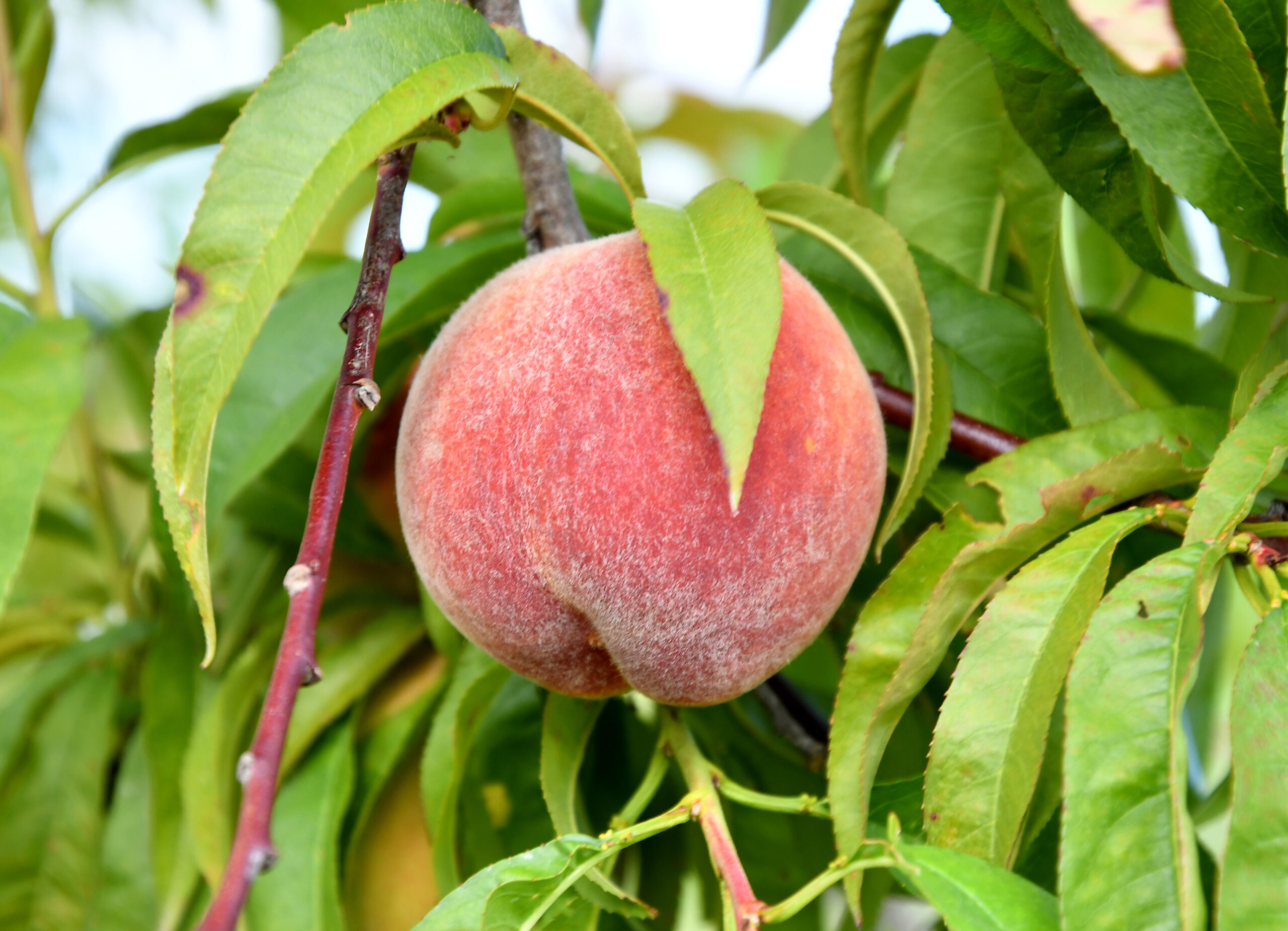
Peaches can be successfully grown in our area. After growing “leaf curl resistant” peach varieties in the garden for many years we are modifying our recommendations. Our wet winter climate promotes peach leaf curl infections which, in particularly wet years, will severely damage even most resistant cultivars unless they are sprayed at the correct time.
Unless otherwise noted, Peaches are self fertile. They can be maintained at 15 feet tall or less and need about 15 feet of spacing. To protect the leaves from infection, spray a fungicide every two weeks, when leaves are dry, from late December through February or in the wettest winters into early March. Lime sulfur, or copper, which are considered organic, are effective. Ziram is even more effective.
We have found that all “resistant” varieties are not equally resistant. The variety Landt was the most resistant to curl but also the most resistant to producing any peaches. The variety Frost was the least curl susceptible while also being very productive. Also somewhat resistant and somewhat productive were the varieties Betty and Charlotte.
So, if you are regularly controlling leaf curl through spraying, why not grow the best tasting peaches for our area. Among the best flavored varieties for our area are Blazing Star, Contender and HW 272. It is important to note that Coryneum Blight and Brown Rot infected peaches in our area along with leaf curl and the sprays applied for leaf curl are somewhat effective on these problems.
Another way to avoid leaf curl is if the plant is kept dry during January and February. This can be done by covering with plastic or by training in a fan shape on a south facing wall under the eaves. In March the plastic, if it is used, can be removed. The plastic sheeting hanging from the eaves may be used in the late summer and fall to increase heat needed to sweeten the fruit.
Since peaches fruit on one year old wood the fan shape allows renewal of one year old wood for best production. Or you can grow genetic dwarf peaches and nectarines. These grow to only 3-4 feet tall but are loaded with tasty fruit. They are also offered as a combination tree with two varieties on the same tree. These will avoid curl if covered up by plastic.
What to do if your tree is significantly damaged by leaf curl?
Once a tree is largely defoliated it often will never be in good shape again because the buds on the branches near the main trunk are killed and the tree in the future only produces on growth at the end of the branches. A way to try to re-shape the tree is to find new growth right near the main trunk and cut all the branches way back to this new growth. Even if most of the tree is cut back, this can renew your tree. It only works if there is any healthy new growth to cut back to. On healthy peach trees they are cut back to new branches close to the trunk. Unlike apples which bear fruit on long lived spurs on older branches, peaches bear fruit on new wood and therefore need to be pruned back to keep producing wood near the trunk.The evaluation below is from 2024, a very bad leaf curl year. Also the sprays for curl were not done that year. Number 1 is no or very little leaf curl and 5 is almost defoliated from leaf curl. It shows that the varieties Frost, Alstar and Betty were the only varieties with good fruit set and only moderate curl. Note this is only one year of evaluation but it has caused us to amend and further consider our reliance on “curl resistant varieties” grown without sprays.
| Variety | Damage | Fruit Set |
| All Star | 2 | Moderate |
| Autumn Rose | 5 | Light |
| Avalon Pride | 4 | None |
| Betty | 2 | Moderate |
| BlackBoy | 4 | None |
| Charlotte | 2 | Light |
| Frost | 2 | Moderate |
| Indian Free | 4 | None |
| Landt | 1 | None |
| Mary Jane | 4 | Light |
| Naniamo | 5 | Light |
| Salish Summer | 4 | None |
| Township | 5 | Heavy |
Descriptions and Location of the Peach Tree varieties