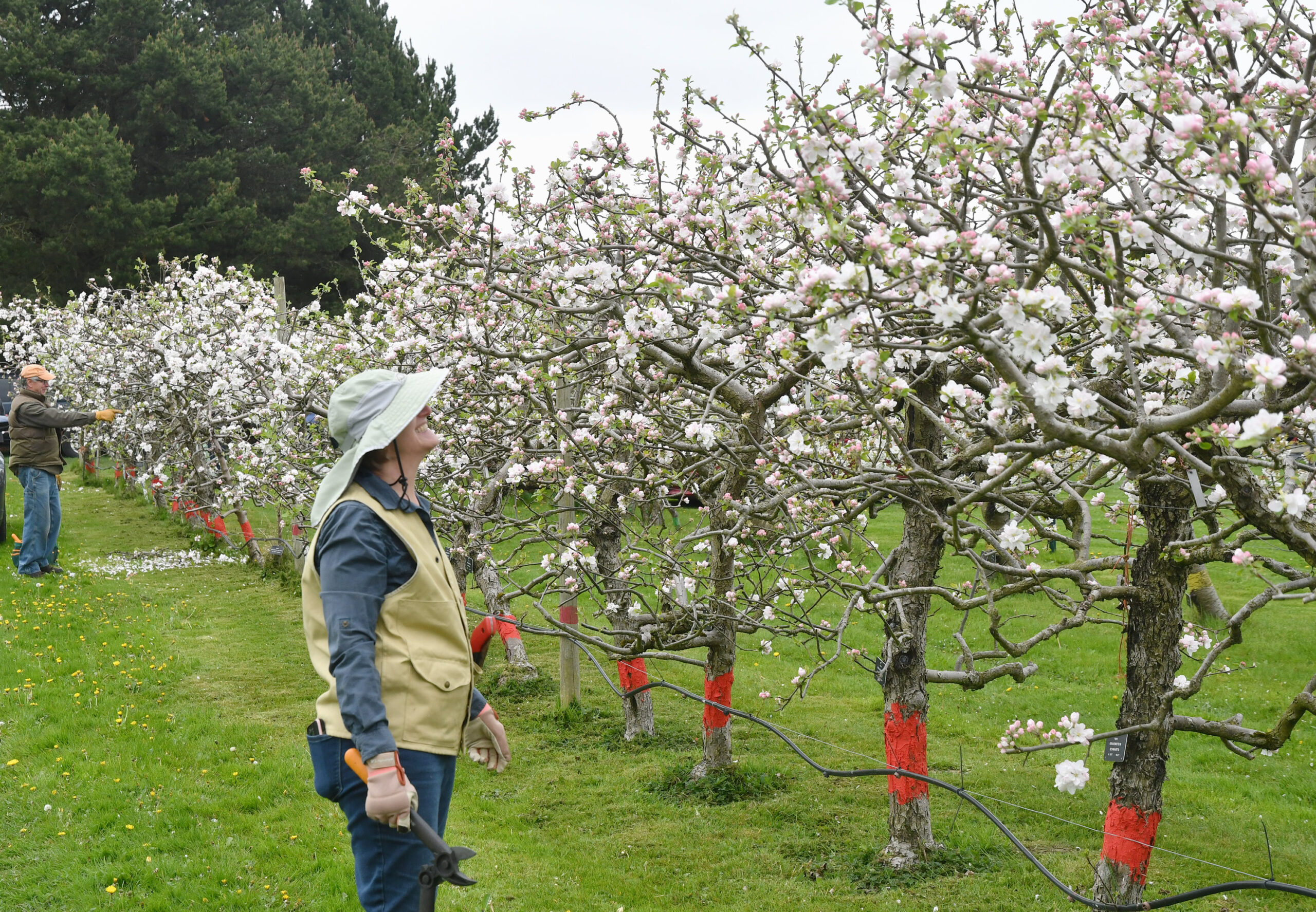
(Located E1, O through V5 planted 2008) We have fifteen different “strains” of Gravenstein apples growing on a double sided “tatura” type of trellis. Gravenstein is a triploid variety, meaning it cannot pollinate itself or other apple trees. It, like other “triploids” has a tendency to grow very large, even on dwarfing rootstock. Our plants are grafted on EMLA 27 rootstock which keeps our trees at under eight feet tall. The trees were planted in 2008.
Harvesters have long noted that our many trees have fruit that has a similar flavor but is variable in terms of size, shape, color and with a one to two week variation in ripening period. Our Gravenstein block leader Bob Baines and others, in taste tests, detect a slight variation in flavor among the strains. Gravenstein, with its rich tart flavors remains many people’s favorite eating apple. It tends to be a biennial bearer, setting a heavy crop in August and early September, every other year and a light crop in the alternate year. It makes great pies and blended with other varieties, a rich complex cider. It is not disease resistant but still remains very popular.
More about “Strains”
All of the 15 strains have the DNA of the variety Gravenstein. So how can they be different? The reason is that occasionally a bud on a fruit tree naturally mutates and the resulting branch the bud produces is different from the mother tree. This is called a “sport” that varies from the rest of the tree. These bud mutations, when selected for further propagation, are known as “strains”.
Every once in a while a “sport” will have a trait that makes it useful to keep and reproduce. If you prune a shoot from this sport and graft it onto a tree or rootstock, you can reproduce and spread that “sport” and thereby create a new “strain”. Most fruit trees very occasionally produce bud mutations. For example, a Golden Delicious tree produced a branch in 1937 that was scab resistant and is now known as the Chehalis cultivar. Jonagold has produced many sports that are much redder and are now the more popular “strains” of Jonagold.
We are blessed with our collection of the many Gravenstein strains. It is one of the largest collections of different Gravenstein strains in the nation. They were collected by the work at WSU Mt. Vernon by Dr. Robert Norton along with Gary Moulton, Les Price and Jacky King. Most came from the orchard of the late Nick Botner who collected thousands of apple varieties. His collection lives on because of the work of Joanie Cooper and others. They run the Temperate Orchard Conservancy. They are at P.O. Box 529 Molalla OR. 97038. https://www.temperateorchardconservancy.org/donate/ This unique and irreplaceable collection of varieties will not survive unless they get additional support.
Unfortunately, we do not yet know the origin of most of the strains in the collection before we obtained them from Botner. We would like to know more of the history. As we find out more, we will update our website and tour. We think the Red Gravenstein might be from a bud mutation from a Gravenstein tree growing in Olga on Orcas Island in about 1910. Local catalogs from that time talk about a red gravenstein “sport” that became popular and was sold throughout our area and around the nation.
We think the Schwartz strain is probably from a tree from WSU Puyallup researcher Dr. Chet Schwartz that he planted as a child and he showed Sam Benowitz around 1980, 70 years after he planted it. It had become a large majestic tree in the yard next to his house.
Harry Rosebrook was the president of the Gravenstein growers in and around Sebastopol, California and we presume the strain comes from a tree he selected or was named for him.
The late Dr. Robert Norton told the story that many people came to the Mt. Vernon station seeking the “old time” Gravenstein that was grown by their grandparents. “Dr. Bob” found that there have been numerous different strains of Gravenstein’s in our area and elsewhere for much more than 100 years.
More About Our Gravenstein Collection
The apple variety Gravenstein was documented in Denmark prior to 1670, though the original seedling may have been discovered in Italy much earlier. Like most domestic apples, it is propagated by grafting. For centuries the scions were traded throughout
Europe and beyond, reaching both coasts of North America around 1800. Gravenstein was especially popular during the homestead period in Northern California and the Pacific Northwest.
The Gravenstein apple is highly flavorful. It is aromatic and intensely sharp when eaten fresh. The skin is fragrant and oily, especially after a few days in storage. The flesh is especially juicy and its texture is paradoxically both crisp and soft, though it does go mushy about a week after picking. The famed nurseryman Edward Bunyard stated that “Of Gravenstein it is hard to speak in mere prose.” This collection of varieties can be propagated at home from scion wood available for purchase at our Winter Field Day in March.
Here are the different strains we have growing on our trellis, followed by photos of each. Our trees have problems with anthracnose as do most apple trees in western Washington. We have grafted two trees of each of the strains on EMLA 27 dwarf rootstock and have them growing in our nursery, so we can in a couple of years, be ready to start a new planting if the anthracnose fungus becomes too much of a problem.
Gravenstein Collection Number | Strain | Source