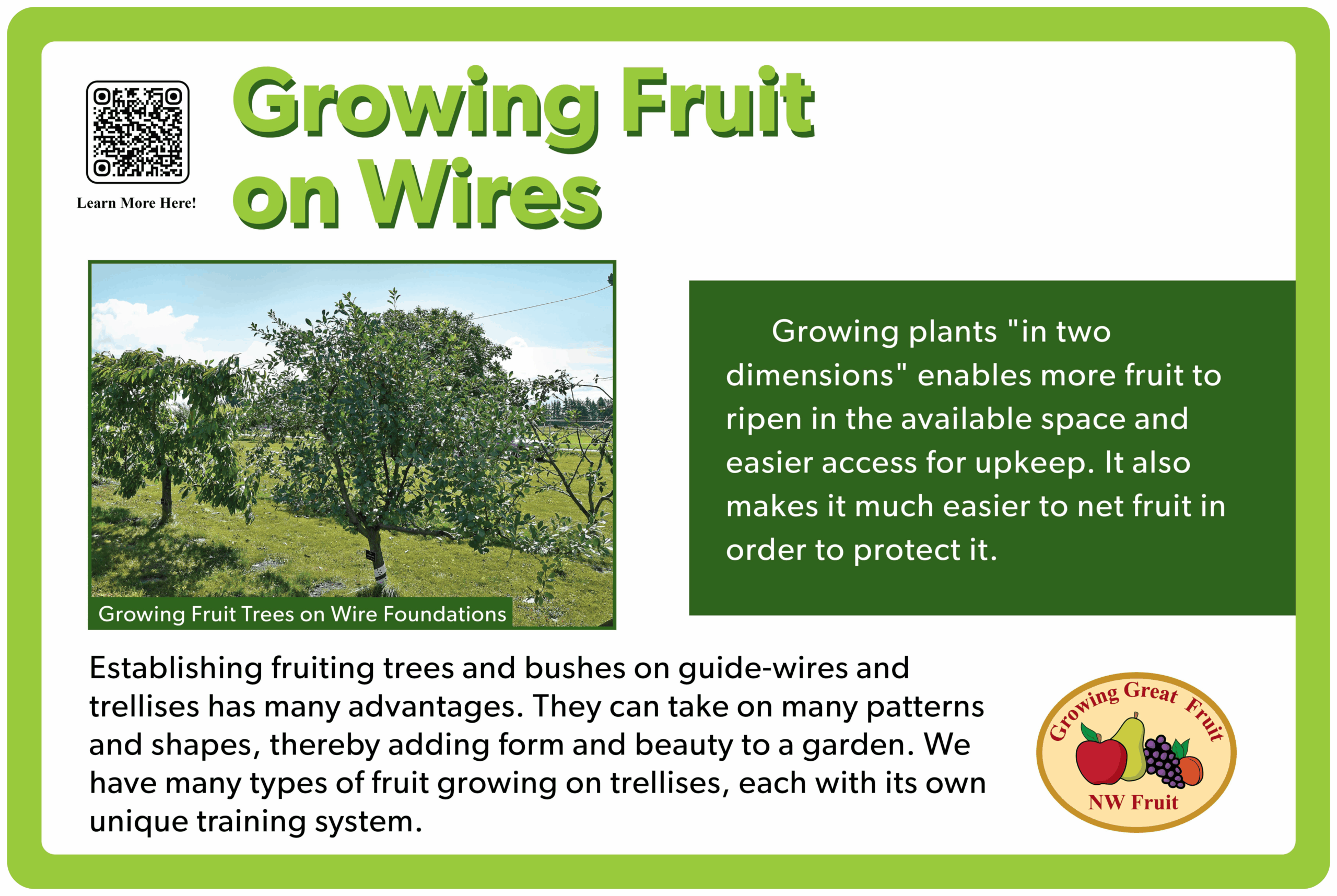
On the trellises in the east garden are many espaliers in beautiful patterns of growing Apples and European pears. Here on the west trellis we are growing Cherries, Quinces, Shipova, Plums and Asian Pears as well as Apples. Each type of fruit has its own growth habit and lends itself to various growing patterns.
Following are descriptions from South to North of the different plantings.
Shipova
First on the trellis is a Shipova. Read about it at Station #41.
Rootstock Comparison
A demonstration showing how the same apple variety grown on different rootstocks differ in the height and width of the needed wires. See Station #29 for more details.
Northwest Heirloom Apples
Read about them at Station #30.
North of these are several additional plantings:
Self-fertile Cherries
Vandelay, Tehraanivee and White Gold, all proven to thrive in our area, are on semi dwarf Gisela 5 rootstock. Growing them on wires enables us to net the fruit and protect it from birds. In order to be able to put the net on as the cherries begin to ripen and take it off after harvest means we tie down and prune back the top branches to fit under the net.
Quince
An Aromatnaja Quince grafted on Quince rootstock is grown as an espalier. We have topworked the following cultivars onto the tree. These include, Portugal, Karp’s Sweet, Seker Gevrick and also Bella di Giugno and Vermont Beauty Pear.
Cherry Fan
Lapins, Hartland and other cherries are grown in a fan shaped pattern well suited for growing and netting cherries grown on wires.
Asian Pear Belgian Fence
The Asian Pear cultivars Yakumo, Kosui, Chojuro and Shinseiki are grown in Y shaped patterns called a Belgian Fence. There is an apple Belgian Fence on the east trellis.
Pollinator Plants
We have chosen pollinator plants that attract bees and other pollinating insects, butterflies and birds. These pollinators also pollinate our fruit trees. Read about them at Station #40.
UFO Cherry
Finally a Cherry tree is grown in a UFO pattern where the main trunk of the cherry is planted almost horizontally and the branches grow straight up and bear the fruit. It keeps the fruiting areas so they can be easily netted.