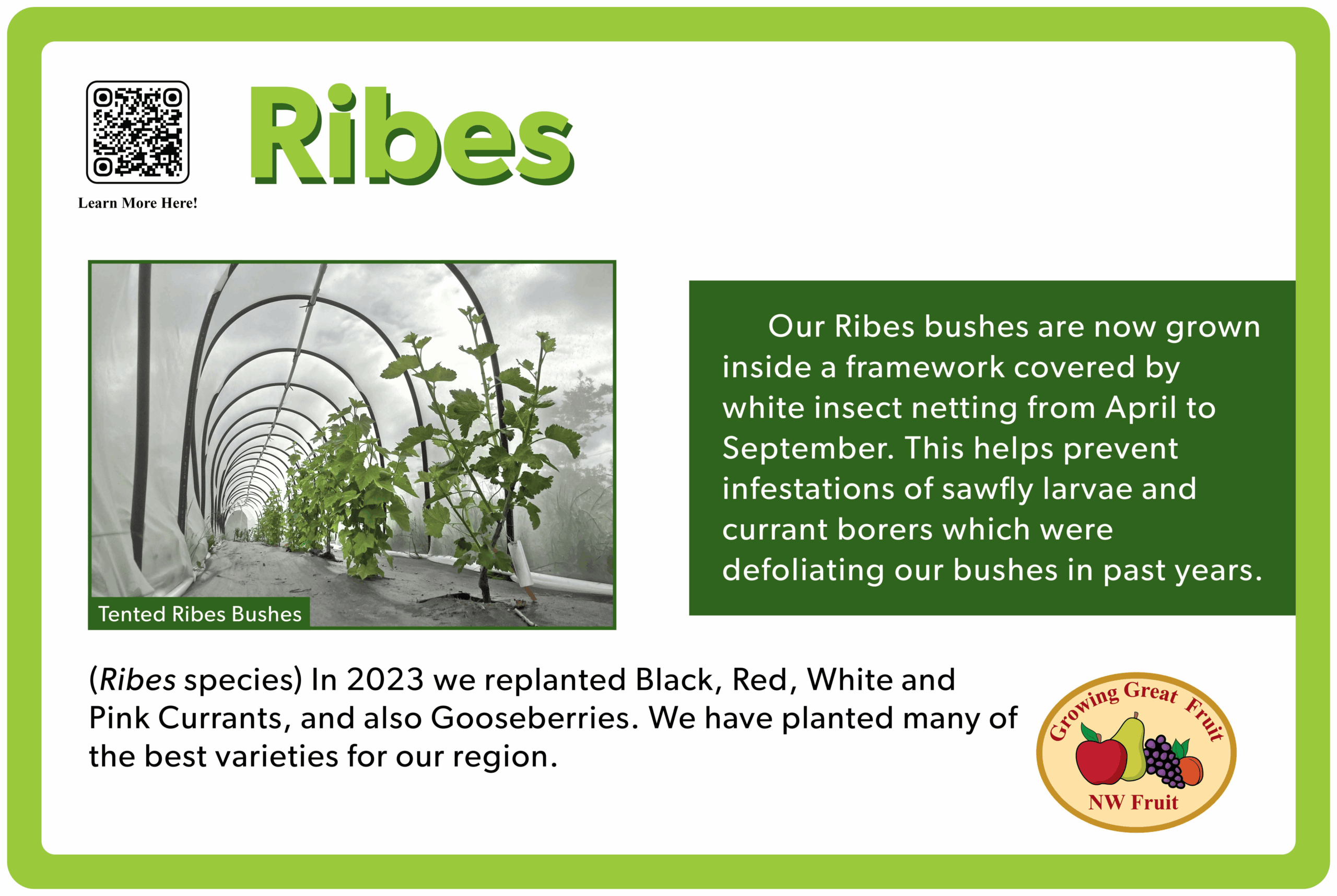
(W3, F 12 planted 2024) Our Currants and Gooseberries are all being grown in a hundred foot long cloche protected by insect netting.
How to Build a Cloche
Adult sawflies lay eggs on leaves that become larvae (photos) that completely defoliate the plant. Working with WSU small fruit specialist Lisa De Vetter and entomologist Louis Nottingham we built a cloche system to protect the plants.
We rotovated and leveled the ground and installed a six foot wide 90 foot long ground cover of landscape fabric that stops weeds from growing through it. We installed a drip irrigation line under the fabric. Dirt or mulch can not be allowed to collect on top of the fabric because weed roots can grow down through the landscape fabric.
At 5’ intervals we cut holes in the fabric and planted into the holes. We pounded in rebar sticking up about a foot at 5’ intervals and attached flexible plastic pipe to make arches that are almost 5’ tall. Using clips we attach the insect netting to the arches. We put the netting on in the spring before the sawflies hatch and invade the gooseberries and currants. We peel the netting back when the bushes bloom to encourage pollination and then cover the cloche again. This also stops the current borer which has a blue white moth that lays eggs that introduce borers in June and July.
Lucile Whitman of Whitman farms in Salem Oregon has provided most of the Ribes cultivars in our collection. Learn about each of our Ribes cultivars in the Currant and Gooseberry write ups.

Currants
Our cloche system is designed to stop our currants from being infected by the currant borer. You can identify the borer when you cut into the base of an older cane. If you have the borer the canes will be hollow in the center.
Currants are vigorous plants that we have to prune back to keep them within our cloche. A healthy, mature bush will have 9-12 canes. Remove excess canes from the center to improve light and air circulation. Also remove canes that are low to the ground, unless you wish to propagate by layering. Branches lying on the ground will form roots and may be removed and transplanted. Currants grow in long clusters of berries. On the red, pink and white currant bushes these impressive clusters make the plants very beautiful.
The currants in the Fruit Garden are:
Black currants
Black currants are very high in vitamin C and in anthocyanins. They are very productive and have a strong pungent flavor. They make great preserves. They can be used to make a liquor called cassis.
Black currants prefer damp fertile soils and are widely cultivated both commercially and domestically. On sandy soil they should be mulched and watered with drip irrigation.
Black currants produce the best fruit on one-year-old wood. Cut branches which are older than 3 years old down to the ground in late winter leaving 10-12 strong shoots.
100 grams of black currant berries have about 180 mg of vitamin C.
Want recipes? Check out The Black Currant Foundation.
Hilltop Baldwin
Rated the most flavorful variety for making jelly from 70 cultivars tested at the WSU Experiment station in Puyallup. This legendary English favorite bears a heavy crop.
Minaj Smyriou
A very cold hardy highly productive early season mildew and white pine blister rust resistant cultivar. It grows quickly to 5’ tall.
Ben Lomond
It has been the most popular commercial black currant in Scotland. The bush is compact and easy to grow and prune.
Risager
A flavorful, high yielding rust, mildew and leaf spot resistant cultivar from the Netherlands.
Ben Sarek
The Scottish Crop Research Institute who introduced all the “Ben” varieties, created this compact rust resistant cultivar for the backyard grower. It is easily maintained at 3’ tall and 3’ spacing. Branches can be shaken to harvest the crop.
Titania
A highly productive mildew and rust resistant variety with large fruit that is very vigorous to 6’ tall.
Lentaj
Hill’s Kiev Select
A seedling of the Ukrainian cultivar Cheryeshnava. Sam Benowitz grew thirty seedlings and sent them to famed horticulturist and gardener Lewis Hill in Vermont who selected it as his favorite. It has excellent flavor and is very productive.
Red Currants
Red Jade
Enjoy spectacular long clusters of bright red, translucent fruit. Very flavorful with a hint of tartness.
Rovada
A Dutch red currant that bears loads of large attractive dark red strings of fruit that ripen up to a month later than Jhonkeer.
Cascade
A consistent, easy to grow proven winner in the Northwest. The bumper crops of large sweet red strings of fruit may need to be staked.
Jhonkeer Van Tets
A heavy early season producer from Holland with excellent flavor.
Pink Currants
Pink Champagne
A cross of red and white currants. The translucent pink berries make delicious jellies, syrups or juices.
Gloire de Sablons
Long clusters of pink sweet fruit adorn this compact 4’ upright bush.
White Currants
Primus
A productive cultivar from Slovakia. A compact bush with sweet fruit.
Zitavia
Very disease resistant and one of the earliest ripening of the white currants. Heavy bearing and easy to harvest. From Germany.
American Black Currants
Missouri Giant
(Ribes odoratum) ‘Missouri Giant’ is often called clove currant because of its sweetly fragrant yellow flowers that occur in early spring. These are followed by very large, sweet, flavourful, black berries in late summer. The fruit of this species has a milder flavor than European black currants. A vigorous upright growing bush.
Currant x Gooseberry
Jostaberry
A thornless cross of Gooseberry and Black Currant. The elongated fruit ripens in late June. The leaves are gooseberry like but the fruit turns almost black when ripe. The flavor combines gooseberry with the stronger black currant flavor. It is a vigorous grower and heavy producer.
Orus 8
A very productive black currant x gooseberry from the USDA in Oregon. It has round flavorful dark purple fruit but has thorns.
Gooseberries
Gooseberries are botanically closely related to currants. Historically, they are popular in the British Isles. A classic gooseberry dish in Britain is a “fool”, made by folding cream into the stewed fruit.
They can be eaten fresh or used in desserts such as pies, tarts and crumbles. Mature bushes can yield between 8 and 10 pounds of fruit. Early pickings are more sour and, therefore, more suitable as culinary ingredients. Allow the fruit to ripen for maximum sweetness.
European gooseberries may be nearly as large as a small plum, but are usually less than one inch long. American gooseberry varieties tend to be smaller and perfectly round.
Generally, European varieties have larger fruit and are more difficult to propagate than Americans but either type is easy to propagate by cutting or layering. They will often layer themselves if branches are allowed to lie on the ground and then the rooted branch can simply be cut off from the mother plant and moved. Hardwood cuttings can be planted in the fall, before all the leaves have dropped. Leaving some leaves on the top of the cutting can actually enhance rooting (take them off of the lower part). Bushes propagated from cuttings can begin to bear fruit within a few years.
Gooseberries are easy to grow and drought-tolerant, but for best results should be irrigated in our dry summers. Excessive amounts of nitrogen in the soil make them susceptible to diseases.
You can grow gooseberries as free-standing bushes, in hedgerows, or trellised in a fan shape. Pruning should strive to create open forms that let in light and leave room for both next year’s growth and easy harvesting. Since fruit is produced on the previous year’s growth, each spring some of the branches should be cut back to their growth point to encourage new growth, either near the ground or near the bottom of the fan in trellised plants.
The gooseberry varieties grown in the Fruit Garden are:
Invicta
A mildew resistant cultivar from England. It produces heavy crops of green berries even when the bush is very young, hanging in heavy clusters down the length of the branches. Excellent for pies, jam or freezing.
Poorman
Can be eaten out of hand as the green berries turn red when ripe. One of the best American gooseberries.
Leepared
A very heavy bearing Finnish cultivar. A carefree attractive, mildew resistant plant. Berries are tart and great for pies and jams.
Jeanne
Introduced in 2006 by the USDA Germplasm Repository in Corvallis OR. Jeanne is a sweet, full flavored mildew and rust resistant plant that even has less damage from sawfly. The upright 3’ tall bush is an excellent choice for area growers.
Captivator
Has large teardrop shaped fruit, pink when ripe. A cross between European and American gooseberries from Ottawa Canada. Nearly thornless and easy to pick and grow. Has yellow fall foliage.