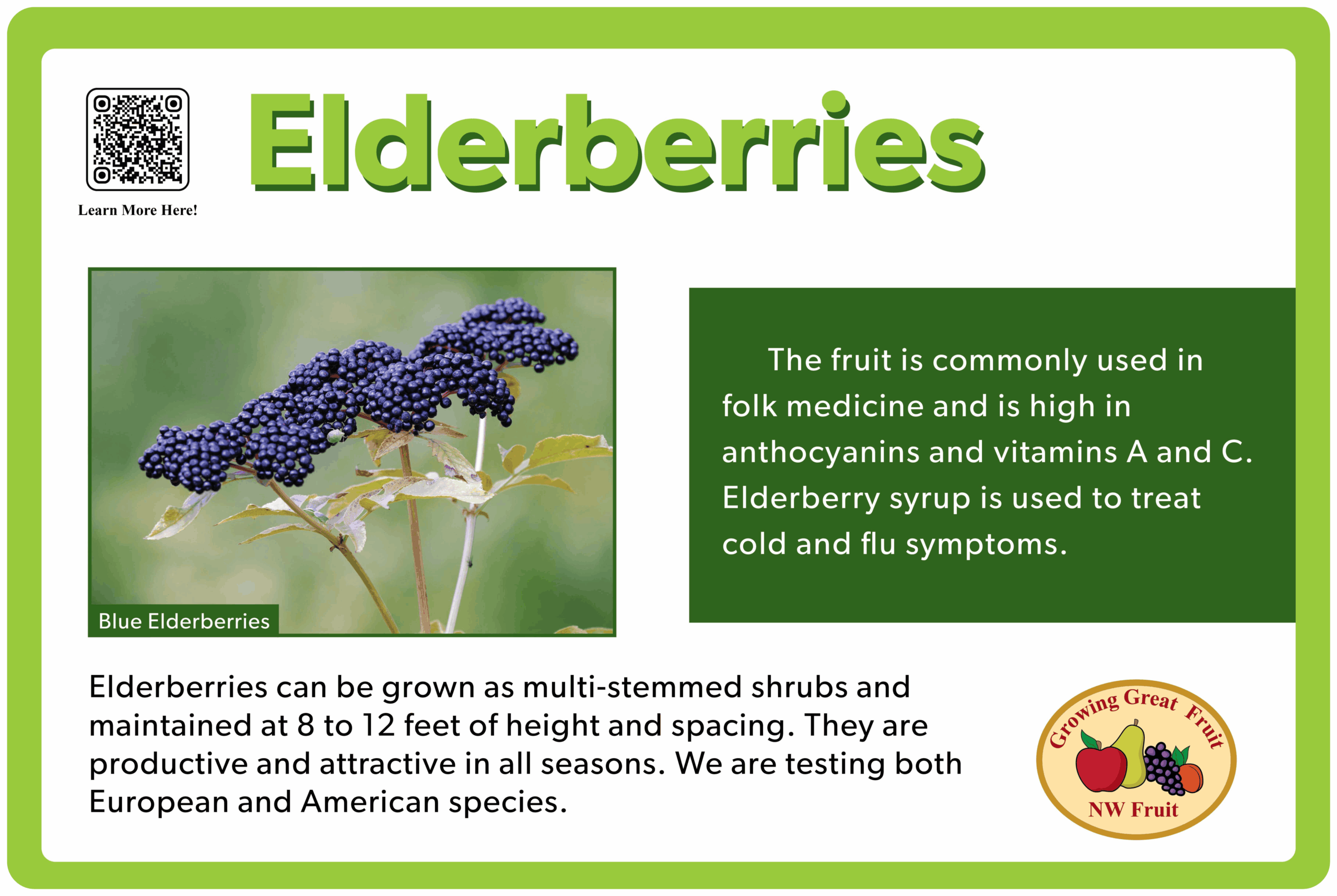
(W5, D23 planted 2025) There are many types of elderberries. They thrive in wetter soil but grow well in well drained soil when watered. The composite flowers are used to mix in a batter to make pancakes. The fruit has many uses. It makes a great healthful syrup, wine or jelly. Elderberry syrup is often used to treat colds. It is very high in pectin and the jelly becomes thick. The hollow stems can be used to make a flute or for other uses.
Ornamentals
Elderberries are edible ornamentals that grow different sizes and are beautiful in all seasons and fit perfectly into niches in your landscape. They can grow in sun or shade. There are variegated cultivars with white or yellow variegation. We have purple leaf ornamentals. And they also have large red purple composite flowers and purple berries that are also edible.
Laced Up
Enjoy the beautiful purple foliage and black berries on a plant that only grows to about 4’ tall and 2-3’ wide.
Black Lace
Black Lace has dark red/purple foliage that is finely cut like a Japanese Maple. Enjoy the masses of large pink composite flowers and edible black fruit. The bush can grow to 6-8’ tall.
European Cultivars
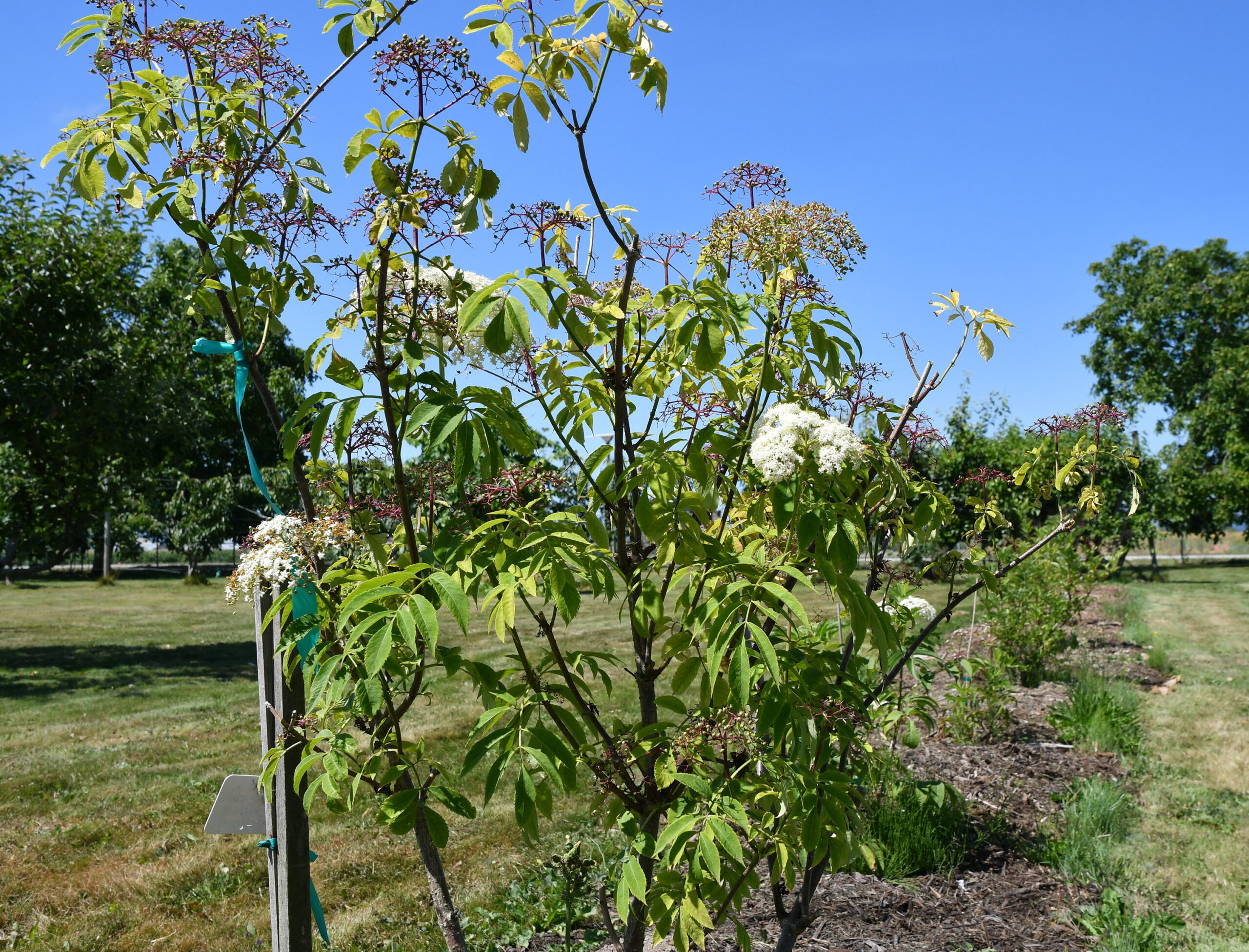
(Sambucus nigra) These European cultivars are grown commercially in many countries and are covered with large white composite flowers and then masses of purple berries. They are beautiful and incredibly productive. They need another European cultivar for pollination. Multi stemmed bushes are upright and grow quickly to about eight feet tall. Prune them by thinning out overlapping branches. If desired, they can be cut to the ground and will regrow.
Hauschberg
From Austria, the bush is vigorous and spreading to 10’ tall. The very large clusters form on long stems. A top rated commercial variety.
Korsor
A leading commercial variety from Denmark. Heavy production on a bush to 8’ tall.
Allesoe
This super productive Danish variety grows to 10’ tall.
Samdal
Samdal is from Denmark. It is a very productive variety.
American Cultivars
(Sambucus canadensis) Equally as nutritious as the Europeans, the American cultivars grow not as tall and are more spreading. When grown commercially many growers cut the plants almost to the ground each year and harvest large crops from new wood each summer. These varieties are from the mid west from Missouri and Oklahoma, bred from selected native plants. We need to evaluate their performance in our climate. The clusters are smaller on the American cultivars than on the Europeans. The Americans seem to be more drought tolerant than the Europeans.
Bob Gordon
From Missouri and a staple of the commercial industry there. Grows to 8’ tall. Very productive.
Wyldwood 1
From Oklahoma with larger clusters. Harvest a couple of weeks after Bob Gordon.
Ranch
Selected from the wild in the Mid West. It is a smaller compact plant.
Native Blue Elderberry
(Sambucus caerulea) This is the Native Blue elderberry that grows wild throughout Western Washington. The native red elderberry (S. racemosa) are more common but they do not have edible berries. The native blue elder can grow as a multi stemmed shrub but it also does grow as a tree up to 35 feet tall. We plan to keep it as a multi stemmed shrub under 15’ tall. It is loaded with large composite clusters of white flowers followed by large crops of edible and beautiful clumps of powder blue berries. It is a gorgeous edible ornamental and is easy to grow.