List of our Pear varieties
Each has a number and letter that identifies where it is in the fruit garden.
Atlantic Queen
(W2, K6 planted 2018) This old time elongated French pear cultivar earns its royal appellation for the huge, up to 1-1/2 lb. each yellow-green fruit it produces in abundance. Enjoy the melting, juicy, aromatic flesh. It thrives in our region and needs to be picked while hard and ripened off the tree. It has resistance to fireblight. Ripens in September. It was brought to the fruit garden by Bill Davis and is among his favorites.
Ayers
(W2, J6 planted 2018) This old variety is favored in the South as the “sugar” pear because the pulp tastes like candy! Medium sized fruit is yellow with a pronounced red blush. This tree is fireblight resistant. It blooms early and ripens in September. It has a low chill requirement of approximately 300-400 hours and has proven to do well in the Pacific Northwest, as well as for our humid Southern growers.
Bella di Guigno
(W4, C18 branch on a trellised quince tree) While others wait until August for a ripe pear, you can enjoy this rich, buttery Italian delight in early July! Red blushed three inch long fruit cover this sturdy, easy to care for tree. Blooms early in season.
Blakes Pride
(W2, I6 planted 2018) A reliable harvest of aromatic, juicy fruit that melts in your mouth. From the USDA program in West Virginia but proven to thrive here. It has excellent resistance to fireblight and seems scab resistant. . Yellow-to-golden skinned with some light russetting, pears are ready to harvest in September.
Bosc
(E1, T through V4 planted 2002) A firm-fleshed, flavorful pear with a beautiful brownish russetted skin and a crunchy texture. Some prefer it to the smooth texture of Comice. Very sweet and juicy when fully ripe. Excellent for baking! Bosc’s are hugely productive. Ripe in October.
Butt
(W2, F6 planted 2025) Used as a pollinizer for Hendre Huffcap as a “perry” cider pear. An October-ripening pear with moderate acids and tannins that produces fruity, slightly astringent of good quality. Fruit is small, yellow, slightly russetted with excellent keeping quality prior to milling. A vigorous tree with narrow-angled crotches. Biennial bearing and heavy producer. Needs a late blooming European pear as a pollinizer.
Clapp’s Favorite branch on a combo tree
(E4, R18 grafted 2023) Clapps’ Favorite is a early ripening variety, ripe in August. It thrives in our area. Stark Crimson is a red sport of Clapp’s Favorite.
Comice
(E2, R6 planted 1995 and E3, R13) Comice (pronounced ko-MEESE) appear in all sizes, but their shape is unique among varieties; having a rotund body with a very short, well-defined neck. They are most often green in color, and sometimes have a red blush covering small to large areas of the skin surface.
However, some newer strains are almost entirely red in color. The Taylor’s Gold is a russeted Comice. The succulent Comice can grow to be very large, and the jumbo-sized beauties are often the ones that appear in gift boxes. An old time pear from France. One of the best cultivars in Western Washington with delicious smooth flesh. It is compatible with Quince rootstock and is used as an interstem.
Conference
(E2, V6 planted 2002) Named for the British National Pear Conference in 1885, Europeans still praise it. This leading French commercial variety is very juicy, sweet and buttery. It is the most productive pear, hanging from the branch in huge banana-like clusters. Attractive, large yellow fruit matures in October with Highland. It keeps until January or longer. The texture is firm and excellent for canning. Ripe in October.
Concorde
(E3, V10 planted 2002) The Concorde pear is a cross between Conference and Comice. Concorde carries the beautiful shape and crisp texture of the Conference, which gives it an elongated neck and firm, dense flesh. Its flavor is vanilla-sweet, reminiscent of Comice pears. Its skin is green, sometimes with golden brown russeting. It ripens in early October.
Gem
(W2 H10 branch on multi graft tree) Large red blushed flavorful fruit ripe late in the season and a good keeper. The best in WSU Mt. Vernon tests of USDA introductions. Very productive at an early age.
Harrow Delight
(W2, H6 planted 2018 and W2, F8 branch on multi-graft tree) A heavy setting, medium-size pear with very good flavor and smooth texture, from the Harrow Station in Ontario, Canada. One of the most precocious Euro pears, regularly starting to bloom and set fruit the year after planting! Resistant to fireblight, cedar trellis rust AND scab! It blooms in late season and ripens in September. A proven winner at the Mt. Vernon station.
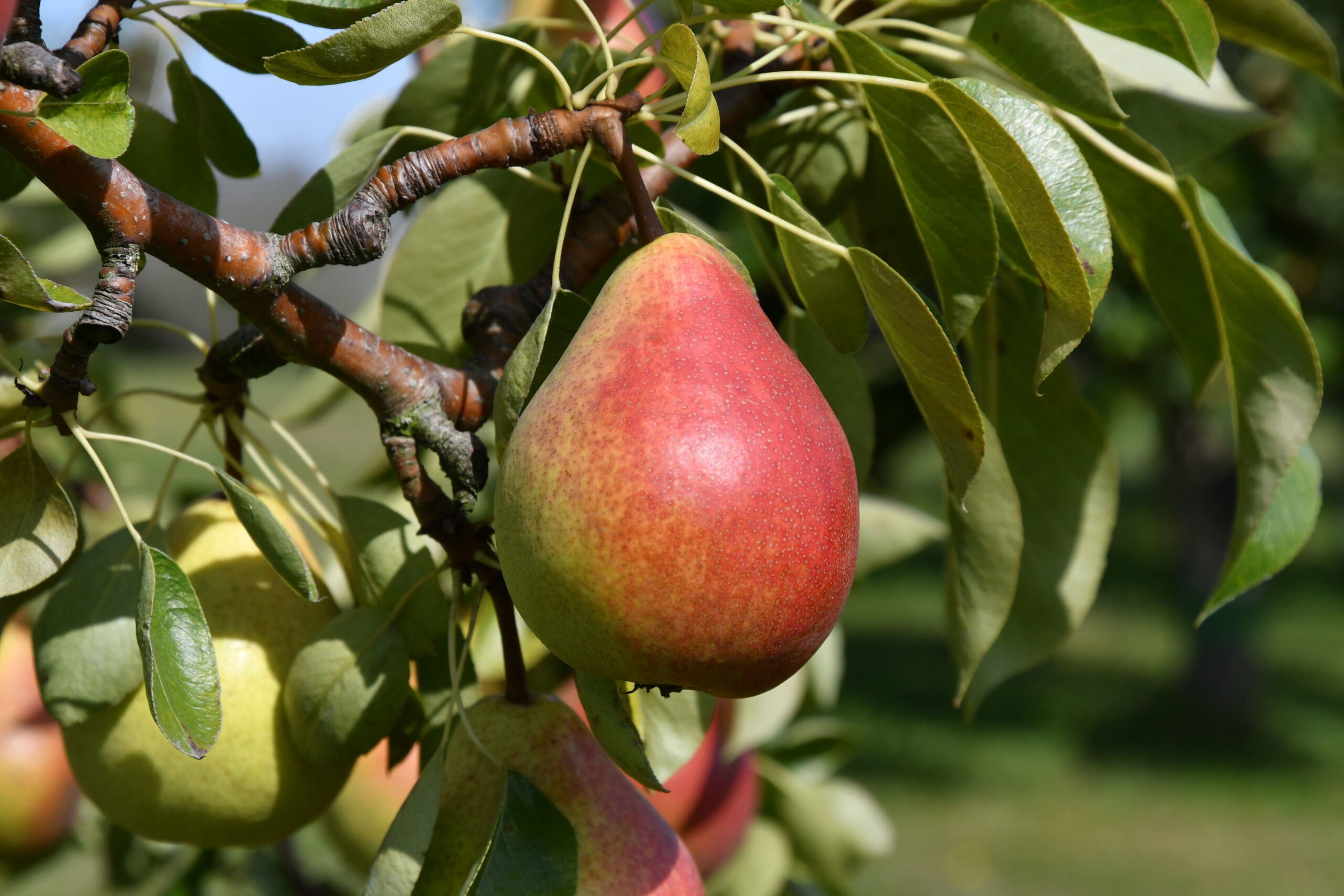
Hendre Huffcap
(W2, E6 planted 2025) This variety has a balance of tannin and acidity that makes it an ideal pear from which to make a single-varietal ‘perry’ pear cider. Tree habit is extremely upright. Ripens in October. Needs an early-blooming European pear as a pollinizer.
Highland
(E3, R13 planted 1999 &W2, F8 branch on multi-graft tree) A quality storage pear; it thrives throughout the nation. This large, attractive dessert pear is yellow with some russetting. The flesh is very smooth in texture and rich in flavor. Trees are very hardy, of moderate vigor and very productive. The fruit matures in early October and develops its best quality if stored for about a month. Pull fruit out of storage and ripen on your counter through the end of the year. Highland was developed at the Geneva station in New York state.
Honeysweet
(W2, H8) You will love the sweetly rich flavor and silky smoothness of Honeysweet! A smooth, buttery pear, similar in texture to the well-known Seckel pear, but larger; Honeysweet ripens to a golden russet. While it resembles a “summer”-style pear, it does require several weeks of cold storage to fully ripen after being picked when mature off the tree in late summer, just after Bartlett. Trees may set fruit without a pollinizer, but fruit will be bigger and more reliable if cross-pollinated. Honeysweet is resistant to fireblight and to leaf spotting diseases, making it great for home gardens and local markets.
Johantorp
A large, very late ripening and cold hardy pear widely grown in Sweden for winter storage. The Johantorp pear will hang on the tree late into the winter. In a mild winter we can enjoy them directly off the tree in late December.
Maxie
(W2, D7 planted 2025) This is a rare cross between Max Red Bartlett European and Nijissiki Asian pears. Maxie has the delicious Bartlett flavor with the crisp, juicy texture of Nijisseki. The fruit is round and a beautiful orange red. It ripens in September and is resistant to pear scab.
Mustabey
(W3, F16 branch on a multi grafted tree) A small, productive mild flavored pear from Turkey, ripe in August.
Onward
(W2, H6 planted 2017) Organic English gardeners love Onward for its ease of growing and reliable production even in years with untimely spring frosts. The medium-size fruit is yellow and sometimes russetted, with a rich, sweet and juicy flavor. It is ripe here in late August. A daughter of the famous Doyenne du Comice. It’s a heavy, precocious cropper and a late bloomer.
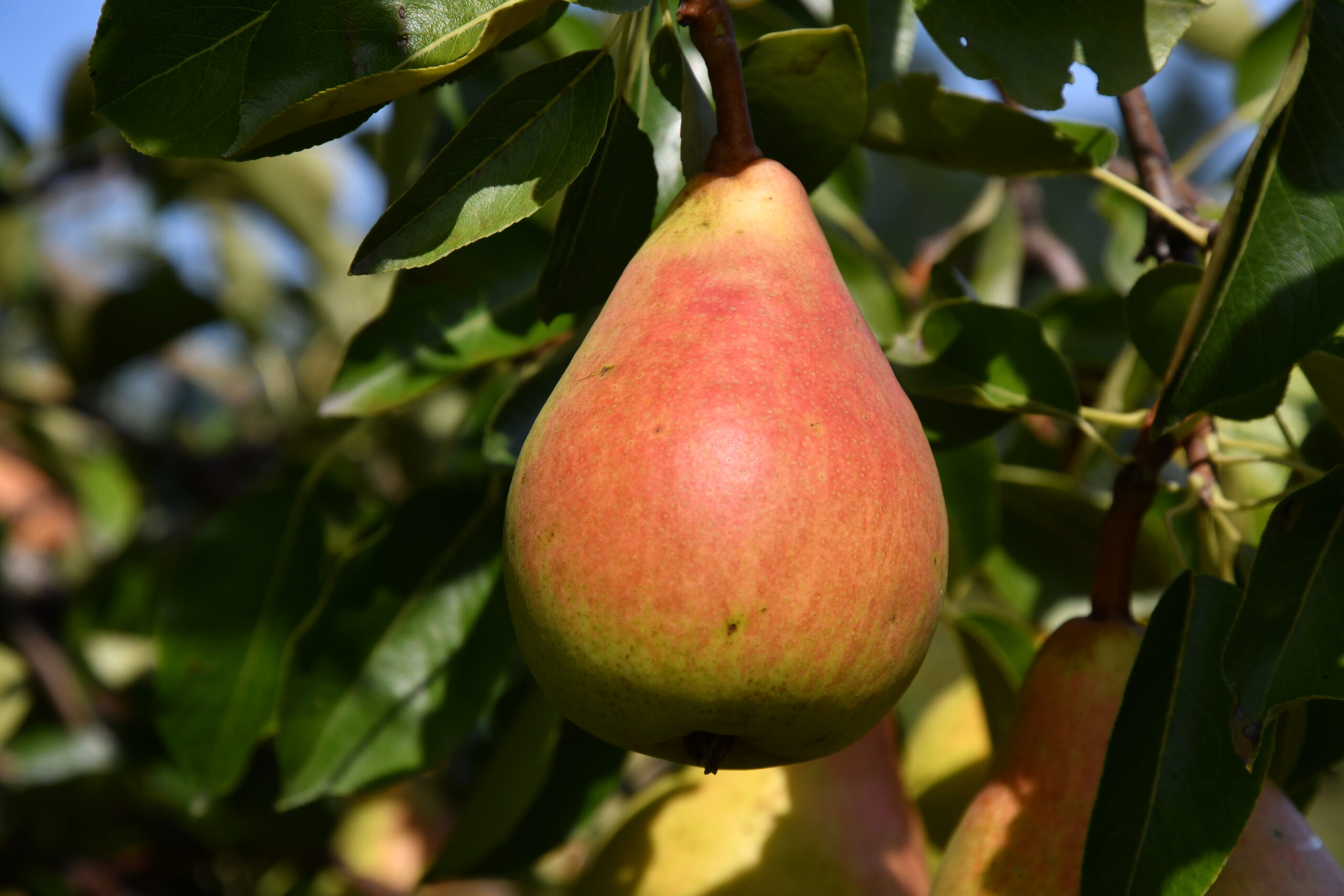
Orcas
(W3, H 14 planted 1999) Horticulturalist Joe Long discovered this tree growing on his property on Orcas Island, WA and took it to the Mt. Vernon station for evaluation in 1972. it has become a regional favorite. The fruit is large, flavorful, and yellow with a carmine blush when perfectly ripe. The texture is smooth, slick and features very few grit cells. Orcas is scab resistant. The tree has a vigorous, spreading habit and bears prolifically every year. The pears are great for canning, drying or eating fresh; they mature in early September. Since the tree is a late bloomer (even though it’s an early ripener), it’s great to match as a pollinizer with a later-ripening keeper variety like Bosc or Seckel.
Pound
(W2, F8 branch on multi graft tree) One of the largest winter storage pears, each fruit weighing a pound or sometimes two. Pound was a favorite for hundreds of years in America, England and France – where it is called Belle Angevine. Pound possibly dates back to Roman times. We got our start from a National Park orchard Sam Benowitz, while at Raintree Nursery helped to restore on San Juan Island, WA, near English Camp, that was originally planted in 1870. The original pear trees are still thriving there. The green pear has firm flesh that turns yellow and is delicious when stored and cooked in the winter. Historically it was sometimes baked whole, wrapped in pastry crust. Reliably productive, it is a mid-season bloomer. Pick it while it is hard in late October or November. It is very late to mature, and never fully softens – a classic keeper cooking pear.
Rescue
(W4. H18 planted 2002) A large beautiful red 0ver orange pear. It is scab resistant and an upright vigorous tree loaded with delicious fruit that matures in September and can keep until December. A small core makes it easy to can.
Rescue was found by Knox Nomura, a nursery grower near Buckley, WA. Knox found it near Vancouver Canada in an old shopping center that was being removed. Knox “rescued” scionwood from this original tree, and sent trees to Mount Vernon in 1975 for testing. It was introduced to the trade in 1987. He modestly did not want it named after himself and instead wanted it named Rescue. Knox was a beloved nurseryman and teacher and was responsible for introducing most of the Asian pears in the fruit garden.
Seckel
(W2, F6 planted 2025) The famous small, but very sweet, heavy-setting variety is known as the Sugar Pear. It has yellow russetted skin and extraordinary flavor. It does get scab. It is a late-blooming pear that needs a different mid or late bloomer for pollination. It ripens in late September/early October and is fireblight resistant.
Spaulding
(W3, H13 planted 1999) If you like the crunchy, juicy, sweetness of an Asian pear and the mellow complex flavor of a European pear, you will love Spalding. A healthy, vigorous tree produces loads of medium size, round, light green fruit in early September. Originally from the South, it thrives in the Pacific Northwest – and even gardeners into Florida grow it!
Summer Blood Birne
(W2, H10 branch of multi graft tree) The “Summer Blood Birne” is an ancient, red-fleshed European pear cultivar from Germany, prized for its unique cinnamon-like flavor and bright red flesh. It ripens in August, is resistant to scab, and is suitable for fresh eating or drying. The pear is small, with yellow skin that often has a red blush.
St. Remy
(W2, F8 branch on multi graft tree) An old Belgian variety producing medium size winter keeper pears. They turn yellow with russetting. They are sweet and juicy and are prized for storing and cooking.
Stuttgarter Gieshirtle
(W2, H6 planted 2018) Recommended by a fruit lover who loved it in her home town in Germany. This sweet two inch diameter russeted pear will hang on the tree, ready to eat during August. It’s a very heavy annual bearer of delicious lunch size fruit. The name means ‘little goat herder.
Starkrimson
(W3, H15 planted 1999) An early, heavy-bearing Red Clapps Favorite. Beneath the fruit’s attractive red skin is a fine-grained white flesh with superior sweet flavor. The tree is vigorous and easy to prune. Fruit ripens 10–14 days before Bartlett.
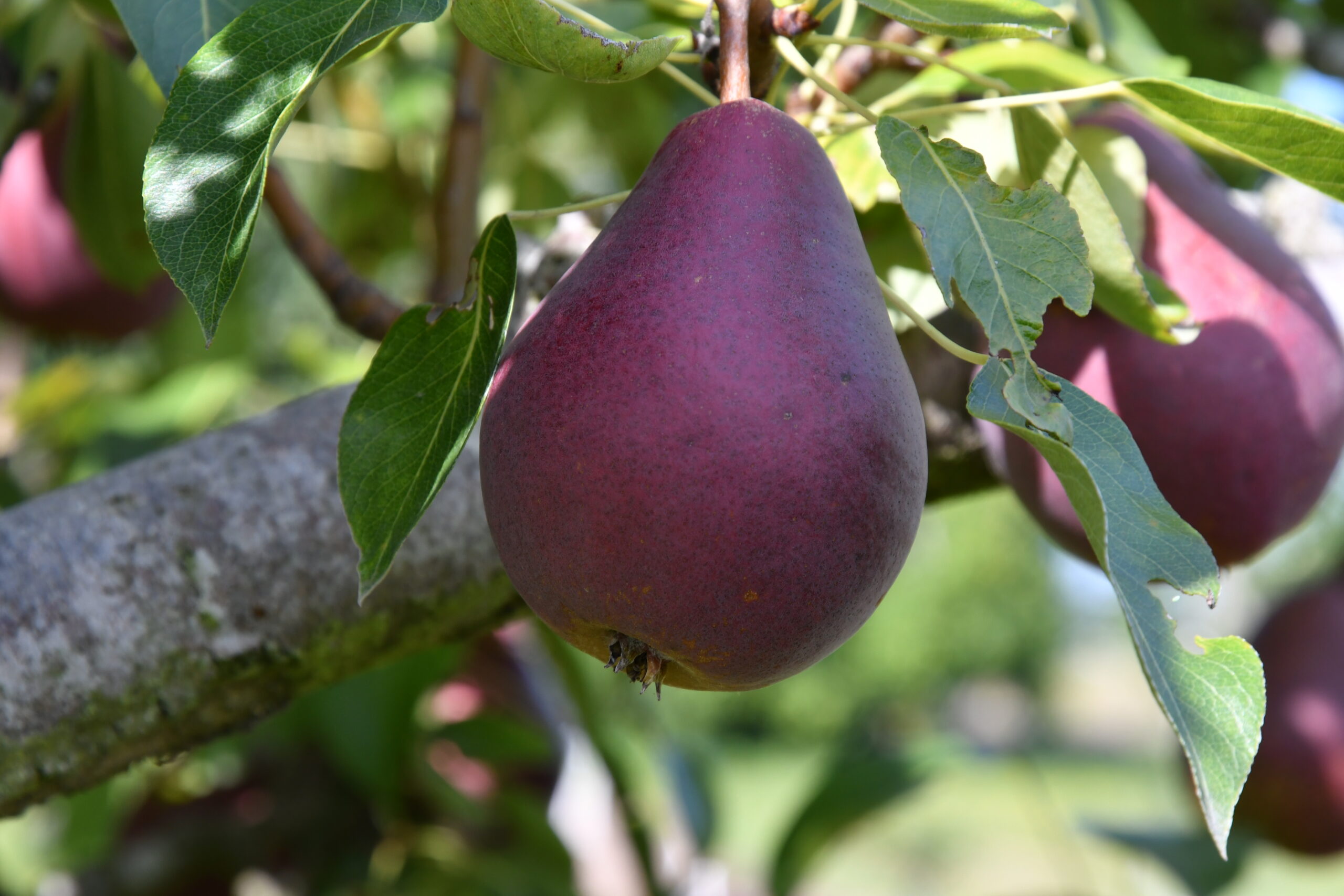
Suij
(E3, R11 planted 2000) Pronounced “Sigh”, this is a pear that you pick while it’s rock hard in October or November and store it in a root cellar and eat fresh through March. This type of pear was popular for hundreds of years in Europe where people used it as a staple food through the winter but has gone out of fashion in the last 80 years. Suij is one of the best of this type. It makes a delicious and beautiful pink pear sauce. It is a cross of Comice and the winter keeper St. Remy, and it both blooms and ripens late. We got it from the Bullock family who got it from Ed Suij on Orcas Island. Ripe in October.
Taylor’s Gold
(E3, V9 planted 2002 &W2, G8 planted 2003) A russetted Comice from New Zealand that thrives in the Pacific Northwest. It ripens in October.
Thorn
(W2, H10 branch on multi grafted tree) A perry pear used as a pollinizer.
Vavilov
(W2, D6 planted 2017) Vavilov is selection PI 337446 at the USDA Germplasm Repository in Corvallis Oregon. It was sent to the USDA in 1968 from the Vavilov Institute in Leningrad Russia. It was named in the U.S. after the famed Russian plant breeder Nicolai Vavilov who the Soviet research stations were named for. It was sent to us by Dr. Joseph Postman of the repository. It was found to be a cross of Rousselet of Stuttgart X Dr Jules Guyot. It ripens in August and is sweet and crunchy with a skin color said to resemble a rainbow trout.
Vermont Beauty
(W4, C18 branch on a trellis quince tree) An old time keeper pear grown in the historic orchard planted near English Camp on San Juan Island near English Camp and still thriving 150 years later. Pick in late October.
Warren
(W2, H6 planted 2018) Warren is juicy and sweet with a buttery texture, and very good keeping abilities. Discovered in Hattiesburg, Mississippi by noted horticulturist T. O. Warren. Grown mostly by Southern growers, it does well in most of the nation. Fruits are medium to large, have a teardrop shape and green skin. Ripe in October.
Wenatchee Gold Bosc
(W2, F10 planted 2003) A Bosc with a lighter brown russet than other Bosc and possibly a little larger fruit.
White Doyenne
(E4, R18 planted 2018) This ancient French cultivar is prized for its melt-in-your-mouth texture and superb flavor, both fresh and cooked. Tastes like a fine, rich buttery chardonnay, sweet-yet-tart, with musky undertones and a strong perfume. The favorite pear of famous chef Alice Waters! It ripens in September. Early bloomer; match with another early or mid-season bloomer for effective pollination. Lasts up to 3 months in storage. Some fireblight resistance. The tree produces well in our region and has a wonderful flavor.